Common PAT Testing Terms You Need to Know
Ever been confused by PAT testing terminology? Not sure what different appliance classes mean, or what certain electrical terms refer to?
This guide provides a clear list of PAT testing definitions to help you better understand the terminology used when carrying out in-service inspection and testing of electrical equipment.
Definitions
Accessory – A device that is ‘other than current-using equipment’. Accessories are typically associated with equipment or the wiring of an installation.
Appliance – Any item that uses electrical energy, other than a luminaire or independent motor. Appliances are further categorised by type and class to determine appropriate testing requirements.
Appliances or Equipment for Building-In – Appliances designed to be installed within cupboards, recesses, or similar spaces. These may not have a full enclosure on all sides.
Basic Insulation – Insulation applied to live parts to provide basic protection against electric shock.
Circuit Protective Conductor (CPC) – A protective conductor that connects exposed conductive parts of equipment to the main earthing terminal. Commonly referred to as the earth conductor or earth wire.
Class 0 Equipment – Equipment that relies solely on basic insulation for protection. Class 0 equipment is not permitted for use in most UK environments and should not be found in service.
Class I Equipment – Equipment that relies on basic insulation and an earth connection for protection against electric shock.
Class II Equipment – Also known as double insulated equipment, these appliances have two or more layers of insulation and do not require an earth connection.
Class III Equipment – Equipment supplied by SELV (Separated Extra Low Voltage), reducing the risk of electric shock.
Cord Set – A flexible lead fitted with a plug and/or connector used to connect equipment to a power supply.
Competent Person – A person with sufficient knowledge, training, and experience to carry out inspection and testing safely and correctly.
- Understanding of electrical principles
- Knowledge of the equipment being tested
- Awareness of electrical hazards
- Ability to determine whether equipment is safe to use
Current-Using Equipment – Equipment that uses electrical energy and converts it into another form, such as light, heat, or motion.
Danger – The risk of injury from electricity. Proper training and procedures are essential to minimise electrical hazards.
Direct Contact – Contact with live electrical parts, which can result in electric shock.
Double Insulated – Equipment designed with two layers of insulation for increased protection.
Earth – The reference point in an electrical system used to safely dissipate fault current.
Electric Shock – The effect of electrical current passing through the human body, which can be fatal.
Electrical Equipment – Any item that uses electricity to operate, including appliances, tools, and devices.
Electrical Installation – A fixed wiring system used to supply electricity within a building.
Enclosure – The outer casing that protects equipment and prevents access to live parts.
Exposed-Conductive-Part – A conductive part that can be touched and may become live under fault conditions.
Fault – A condition where current flows in an unintended path.
Fault Protection – Measures designed to protect against electric shock under fault conditions.
Fixed Equipment – Equipment that is permanently installed and not intended to be moved. It is not normally subject to PAT testing but should still be included in maintenance and inspection regimes where appropriate.
Flexible Cable – A cable designed to bend and flex during use, commonly found on portable appliances.
Fuse – A safety device that interrupts the circuit when excessive current flows.
Hand-Held Equipment – High-risk equipment intended to be held during use. These items typically require more frequent inspection.
Indirect Contact – Contact with exposed conductive parts that have become live under fault conditions.
IT Equipment – Electronic equipment such as computers and monitors. These may require alternative test methods, such as reduced voltage insulation testing or leakage testing, to avoid damage.
Instructed Person – A person who has been advised of electrical hazards and trained to avoid them.
Insulation – A non-conductive material used to prevent current from escaping conductors.
Isolation – The disconnection of equipment from the electrical supply for safety purposes.
Leakage Current – Current that flows outside its intended path, typically to earth.
Live Part – A conductor or part intended to be energised during normal operation.
Movable Equipment – Equipment typically up to 18 kg in weight that can be easily moved, often with wheels or castors.
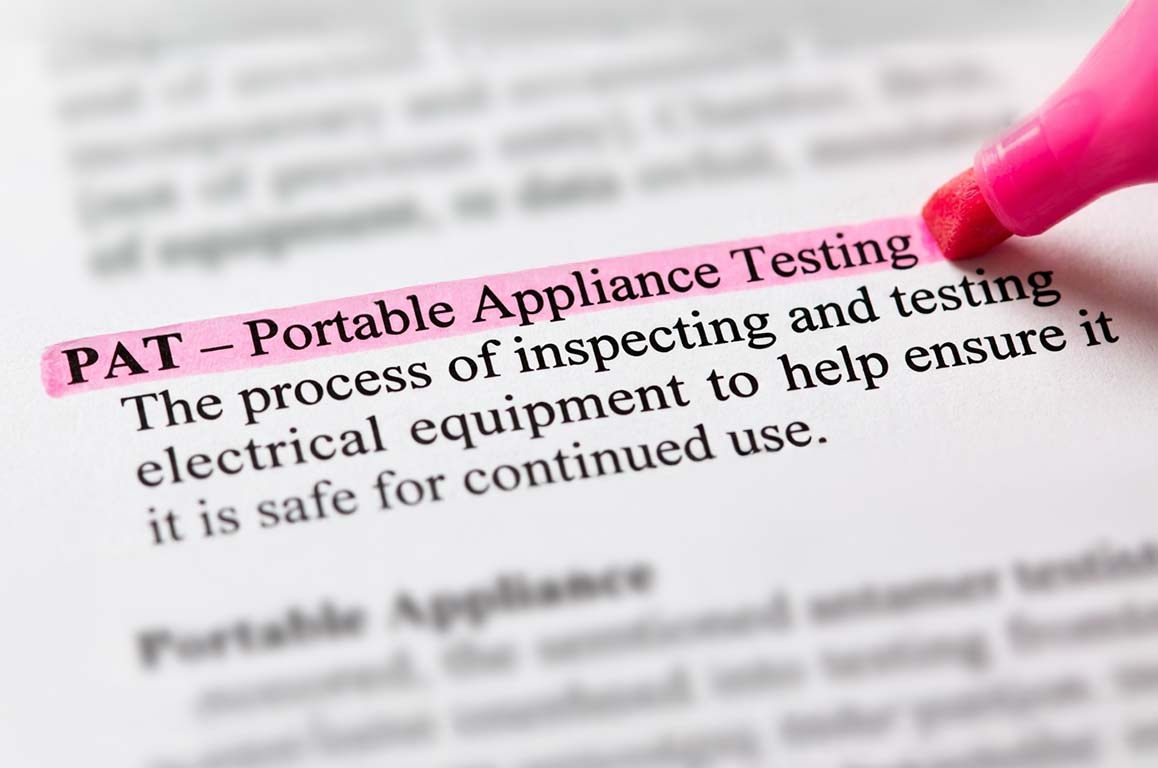
PAT (Portable Appliance Testing) – The process of inspecting and testing electrical equipment to help ensure it is safe for continued use.
PAT Instrument – A device used to carry out electrical safety tests on appliances.
Portable Appliance – An appliance weighing less than 18 kg that can be moved while connected to the supply.
Protective Conductor – A conductor used to connect exposed metal parts to earth, providing protection against electric shock.
Reinforced Insulation – A single insulation system that provides a level of protection equivalent to double insulation.
RCD (Residual Current Device) – A device that disconnects the supply when an imbalance in current is detected.
SELV (Separated Extra Low Voltage) – A system designed to operate at low voltage to reduce the risk of electric shock.
Skilled Person – A person with sufficient technical knowledge and experience to avoid electrical dangers.
Socket-Outlet – A fixed installation designed to accept a plug.
Stationary Equipment – Equipment over 18 kg in weight that is not easily moved but may still be subject to inspection and testing where appropriate.