Why Understanding Electrical Terms Matters in PAT Testing
Before starting a PAT testing course, it is important to understand the basic electrical terms used throughout training and assessments.
PAT testing is based on electrical safety, and many of the decisions made during inspection and testing depend on understanding what voltage, current, resistance, and power actually mean in practical terms.
Having this foundation makes it much easier to understand test results, identify potential risks, and apply safe and consistent judgement when working with electrical equipment.
Ohm’s Law
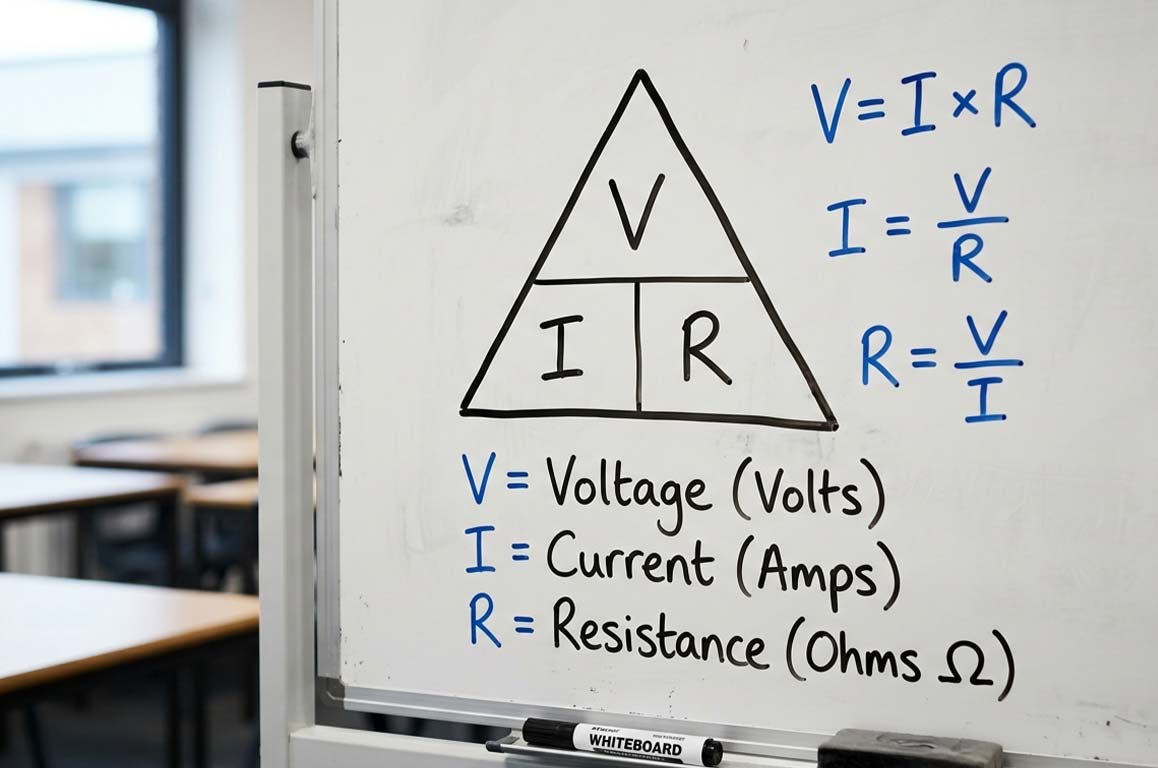
Ohm’s Law describes the relationship between voltage, current, and resistance in a circuit.
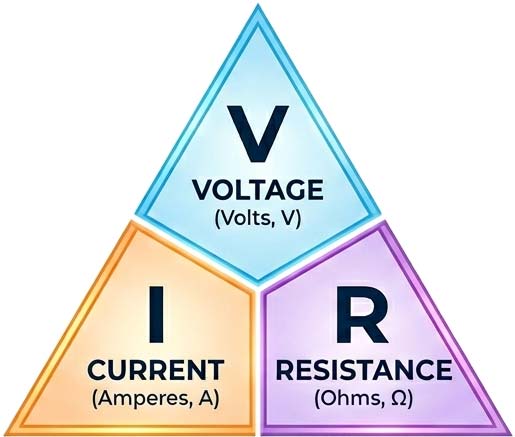
Voltage (V) = Current (I) × Resistance (R)
This can also be rearranged as:
Current (I) = Voltage (V) ÷ Resistance (R)
Resistance (R) = Voltage (V) ÷ Current (I)
These relationships are fundamental when understanding how electrical systems behave.
The symbol for current is I, derived from the French term intensité, meaning current intensity.
The amount of current in a circuit depends on both the applied voltage and the resistance of the circuit.
Voltage (V)
Voltage is the electrical potential difference between two points. It is the force that drives current through a circuit.
You can think of voltage as similar to water pressure in a pipe — the pressure is what causes water (current) to flow.
If there is no voltage, no current will flow.
Voltage is therefore the driving force behind electricity and is essential to all electrical circuits.
In the UK, the nominal mains voltage is 230V AC at 50 Hz, although this can vary within permitted tolerances.
Current (I)
Current is a measure of the flow of electric charge through a conductor — in simple terms, the movement of electrons through a circuit.
The larger the current, the more charge flows through the conductor.
Current is measured in amperes (A), often referred to as “amps”.
Resistance (R)
Resistance is the opposition to the flow of current within a material.
Some materials allow electrons to flow easily, while others restrict their movement. This is similar to how a restriction in a pipe would reduce the flow of water.
Resistance is measured in ohms (Ω) and is represented by the symbol R.
The higher the resistance, the more difficult it is for current to flow.
Power (P)
Power refers to how much electrical energy is used or transferred in a circuit.
It is measured in watts (W).
Power is linked to how much electricity is flowing and how much “push” (voltage) is available. In simple terms, the more voltage and current involved, the higher the power.
Power can most commonly be calculated using the following relationship:
Power (P) = Voltage (V) × Current (I)
There are also two alternative forms, used when resistance is known:
Power (P) = Voltage (V)² ÷ Resistance (R)
Power (P) = Current (I)² × Resistance (R)
These are simply different ways of working out the same value depending on what information you have.
In practical terms, higher power appliances — such as heaters and kettles — use more energy and produce more heat, which can increase the risk if a fault occurs.
Alternating Current (AC) & Direct Current (DC)
There are two main types of electrical current: alternating current (AC) and direct current (DC).
Alternating Current (AC) is used for mains electricity. The direction of current flow changes continuously — in the UK this occurs at a frequency of 50 Hz.
Direct Current (DC) flows in one direction only and is commonly used in batteries, electronic devices, and low-voltage systems.
Most modern electrical equipment converts AC from the mains supply into DC internally for operation.
Additional Practical Notes
- In routine inspection and testing, complex calculations are rarely required
- Test instruments automatically measure values such as resistance and current
- The key skill is interpreting results and identifying potential risks
PAT Testing Courses



Summary
Voltage drives current, resistance limits it, and together they determine power.
These fundamental principles underpin all electrical systems and are essential for understanding how faults occur and how testing verifies safety.
While the theory remains unchanged, modern electrical safety practice focuses on practical application, correct testing, and risk-based judgement.