Understanding the Earth Leakage Test
Earth leakage testing (now more correctly referred to as protective conductor current testing or touch current testing) measures any current flowing from live parts of an appliance to accessible conductive parts under operating conditions.
The purpose of the test is to confirm that any leakage current remains at a safe level and does not present a risk of electric shock to the user.
In modern PAT testing practice, leakage testing is often used as a supplementary test rather than a mandatory replacement for insulation resistance testing. It is particularly useful where insulation testing is not suitable, such as on equipment with electronic controls, suppression components, or complex internal circuitry.
Many PAT testers automatically include leakage testing within their test sequences. However, it is important to understand that some testers apply leakage tests in situations where they are not strictly required, which can sometimes lead to unnecessary or misleading fail results if not interpreted correctly.
Why Measure Leakage Current?
The leakage test can be understood as an alternative method of identifying insulation breakdown. For example, if insulation in a Class I appliance fails, current may flow to exposed metal parts and present a shock risk.
A standard insulation resistance test at 500V DC will often identify this condition. However, a leakage test can be useful where:
- The appliance has electronic switching that only operates when energised
- The insulation resistance test gives inconclusive or unstable results
- The equipment contains suppression or filtering components that affect insulation readings
Unlike insulation testing, leakage testing is performed with the appliance energised at normal operating voltage, meaning the equipment may run during the test and appropriate safety precautions must be taken.
Class I – Protective Conductor Current Test
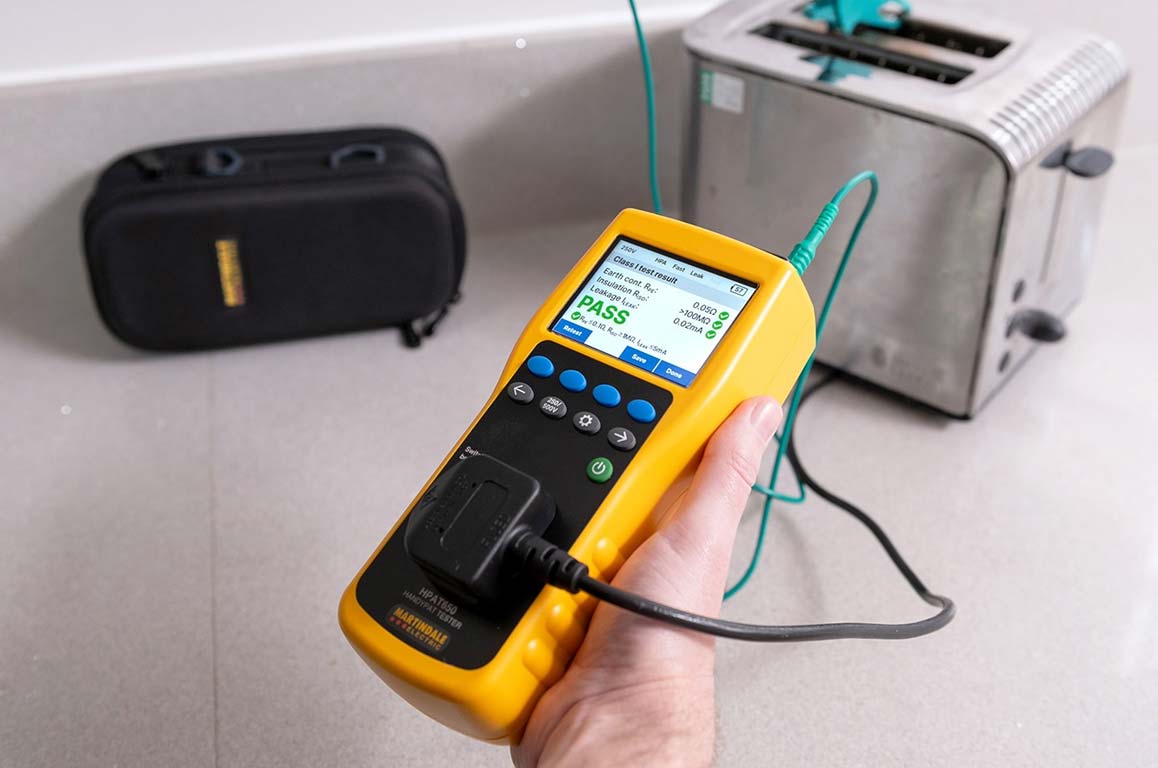
For Class I appliances, protective conductor current testing measures the current flowing through the earth conductor during normal operation. This is achieved by powering the appliance through the PAT tester while measuring current in the protective earth conductor.
Because the appliance is energised during the test, it is essential to ensure it is safe to operate and securely positioned before testing.
It is also important to ensure the appliance is tested in isolation, as connected equipment may provide alternative return paths for current and affect readings.
It is not necessary to connect a separate test lead to the appliance casing during this test, as the earth connection via the plug has already been verified during the earth continuity test.
Class II – Touch Current Test
For Class II appliances, a touch current test is used instead of protective conductor current testing, as there is no earth connection.
A test lead is connected to accessible conductive parts such as metal screws, chucks, or external metal components to measure any current that could flow to earth through a user.
As with Class I testing, the appliance may operate during the test and must be safely secured before energising.
Pass Criteria & Interpretation
Under the current IET Code of Practice (5th Edition), leakage current limits are no longer treated as rigid universal values. Instead, acceptable leakage levels are based on appliance type, risk assessment, and manufacturer guidance.
In general modern practice, a typical reference limit of 5 mA is commonly used for protective conductor current, depending on equipment type and test method.
However, it is important to understand that:
- Different appliance types may have different acceptable leakage levels
- Some equipment is designed to operate with higher leakage currents
- Manufacturer data should always take priority where available
Why PAT Testers May Show ‘Fail’
Many PAT testers still in service were designed around earlier editions of the Code of Practice and may display legacy pass limits such as:
- 0.75 mA for portable handheld appliances
- 3.5 mA for IT or stationary equipment
- 0.75 mA per kW (up to 5 mA) for heating equipment
- 0.25 mA for certain Class II touch current tests
These values were commonly used in older guidance but are now considered historical reference levels rather than strict modern limits.
This can sometimes lead to confusion, particularly when older testers produce a fail result on equipment that is actually within modern acceptable leakage ranges.
For this reason, results should always be interpreted alongside insulation resistance results, earth continuity results, and overall risk assessment rather than relying on a single leakage value alone.
Substitute Leakage Testing
The substitute earth leakage test (sometimes called ‘sub leakage’ or ‘I-leak’) is found on some battery-powered PAT testers.
Unlike a full earth leakage test, it does not apply full mains voltage to the appliance. Instead, a reduced voltage is used and the result is scaled to estimate leakage at normal operating voltage. This means the appliance is not fully energised during the test, so some faults may not be detected, particularly in electronic equipment.
The test was included in the 4th Edition of the IET Code of Practice (2012) but was removed in the 5th Edition (2020) due to reliability concerns.
Conclusion
Earth leakage testing remains an important tool within PAT testing, particularly where insulation resistance testing is not suitable or where equipment must be tested under operating conditions.
Modern practice uses risk-based assessment of leakage current, with a commonly applied reference limit of 5 mA depending on equipment type and test method.
Understanding the difference between modern guidance and legacy tester values is essential to avoid unnecessary failures and ensure accurate interpretation of results.