Understanding the Insulation Resistance Test
The insulation resistance test ensures that the insulation surrounding an appliance’s live parts has a sufficiently high resistance level to help prevent electric shock.
It is good practice for the earth continuity test to be carried out before insulation resistance testing. However, this is a procedural approach rather than a strict requirement in all cases.
The insulation resistance test is typically carried out at 500V DC for approximately 5 seconds. PAT testers perform this by internally linking the live and neutral conductors during the test. This ensures there is no potential difference between live parts during the measurement.
Where appliances contain surge protection devices or suppression components, a standard insulation test may produce a false reading or fail result. In these cases, the insulation resistance test may be replaced with an earth leakage or substitute leakage test.
Both Class I and Class II appliances may be subject to insulation testing, although the method and connections used will differ depending on the construction of the equipment.
For sensitive electronic equipment such as IT devices, the test voltage is often reduced to 250V DC where appropriate, based on risk assessment and equipment suitability.
Testing a Class I Appliance
For Class I appliances, the appliance switch should be in the ON position where required by the test procedure.
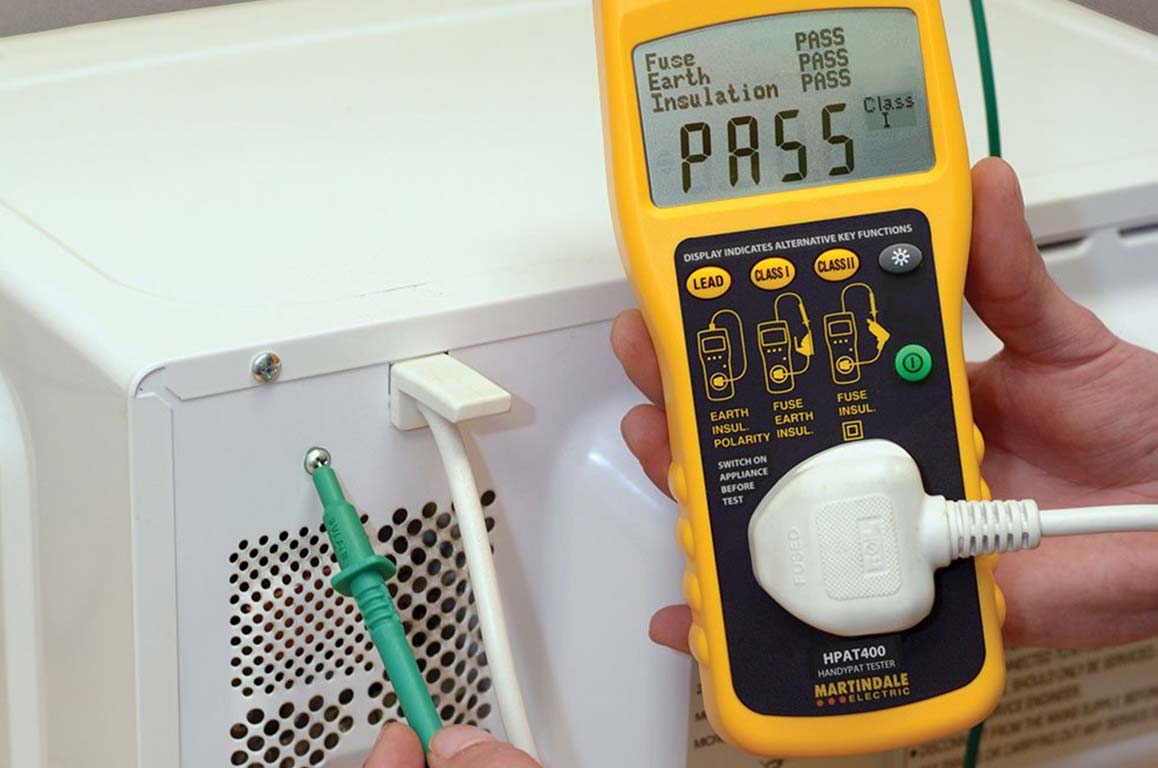
The appliance is connected to the PAT tester and the Class I insulation resistance test is selected. The typical pass limit is 1MΩ or greater.
The tester measures the resistance between the combined live and neutral conductors and earth.
Key Requirement: To pass, the insulation resistance must generally be greater than 1MΩ.
Testing a Class II Appliance
Class II appliances require a slightly different approach as they do not have an earth connection.
The appliance switch should be in the ON position where required by the test procedure.
A test lead is connected to accessible conductive parts of the appliance where applicable, such as metal chucks, exposed screws, or other metal fixings. This helps identify whether any internal live conductors have come into contact with accessible metal parts.
It is good practice to test multiple accessible metal areas where available to ensure a complete assessment of the appliance casing.
Pass Criteria: For Class II appliances, the insulation resistance should generally be greater than 2MΩ between live/neutral conductors and accessible conductive parts.
Testing Appliances with Surge Protection
Surge protection devices are commonly found in extension leads and IT equipment. These devices are designed to protect equipment by diverting excess voltage safely to earth when voltage levels exceed safe limits.
Standard insulation testing is normally carried out at 500V DC. However, this voltage may activate surge protection components, resulting in incorrect or misleading readings. For this reason, many PAT testers include a 250V insulation test setting for sensitive or surge-protected equipment.
Where this option is not available, an alternative test method such as an earth leakage or touch current test may be used where appropriate.
Conclusion
The insulation resistance test is a key part of PAT testing, helping ensure that electrical insulation remains effective and safe during normal use.
Using the correct test voltage and selecting the appropriate method for the type of equipment is essential to avoid false readings and ensure reliable results.