Understanding the Earth Bond Test for Class I Appliances
All Class I appliances are subject to this particular test, which ensures that there is a satisfactory connection between the earth pin in a plug and the case of the appliance.
The earthing of an appliance means it is safer to use, as the risk of electric shock is significantly reduced. Combining proper earthing with standard insulating properties enhances the overall safety of an appliance even further.
This particular test is also commonly referred to as an Earth Bond or Earth Resistance test, but they all measure the same thing.
Performing the Test
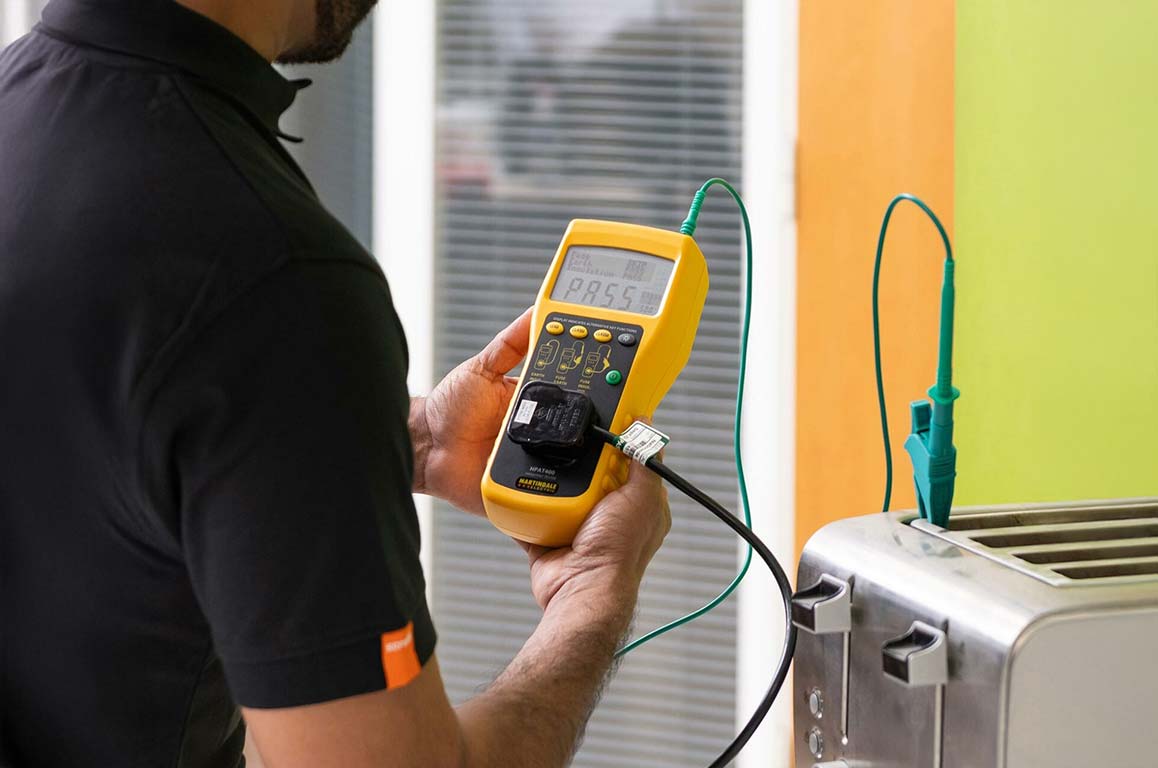
In order to perform an earth continuity test, the appliance’s mains plug must be inserted into your PAT testing device, and a test lead must be connected to a suitable earth point on the appliance.
If you take, for example, a kettle, this test would be performed by plugging the kettle directly into the PAT tester and then clipping a test lead to a metal part of the appliance that is connected to earth.
To pass the test, the reading from the PAT tester must show that the resistance is less than 0.1Ω + the resistance of the supply cable.
Earth Points on an Appliance
One of the key aspects of this test is identifying a suitable earth point on the appliance.
Many appliances have exposed metal parts on the exterior that can be used. However, not every metal point is necessarily connected to earth. If you receive a fail reading, it is good practice to test another potential earth point to confirm the result.
Rusty or corroded metal can also affect the reading. Where possible, connect to clean metal. Alternatively, the crocodile clip can be used to scrape through light corrosion to obtain a better connection.
When testing flat-bottomed kettles where the heating element is not exposed, the test may initially fail. In these cases, test the earth connection on the detachable base, where a proper earth path is usually present.
When testing a PC, try to obtain the earth connection as close to the power supply unit as possible, which is typically where the IEC lead enters the appliance.
Class I Appliances with No Accessible Earth
Some Class I appliances, such as shredders, laptop or monitor power supplies, and desktop fans, may have no accessible metal parts to connect the test lead.
In these cases, it is generally acceptable to omit the earth bond test. If no exposed metalwork can be touched by the user, then the risk of electric shock from accessible conductive parts is significantly reduced.
Earth Bond Test Currents
There are generally two types of earth bond test current used:
- Low current – typically in the range of 100 to 200 milliamps
- High current – typically 10 amps or 25 amps
The earth bond test passes a current along the earth conductor from the plug pin to the body of the appliance. The tester then measures the resistance of that connection.
If the connection is poor, corroded, or broken, the resistance reading will increase.
In simple terms, this can be compared to testing the strength of a rope. The earth wire is like the rope, and the test current is the load. Applying a higher current helps confirm that the earth conductor can safely carry fault current in the event of a problem.
Many modern PAT testers are battery-powered and carry out low current tests (100–200 mA), which are acceptable under the IET Code of Practice.
Mains-powered PAT testers can perform higher current tests (10A or 25A), which provide a more rigorous assessment.
IT equipment should generally be tested at low current (100–200 mA), whereas higher-powered appliances such as heaters and washing machines should ideally be tested at 25A, where the tester allows.
Conclusion
The earth continuity test is a vital part of PAT testing for Class I appliances, ensuring that exposed metal parts are safely connected to earth. By confirming a low resistance path, this test helps protect users from electric shock in the event of a fault.