Why Fuse Ratings Matter in Electrical Safety
As part of your visual inspections, you may find that an appliance’s fuse is incorrectly rated.
It is essential that plugs contain the correct fuse to ensure that, should a fault develop within the appliance, the fuse will blow and disconnect the power supply safely.
For example, a 3 amp fuse allows a maximum current of 3 amps to flow through it. If the current exceeds this limit, the fuse will rupture and cut off the electrical supply.
Choosing the Correct Fuse
The correct fuse should always be matched to the appliance. In practice, fuse selection is usually based on the appliance’s power rating (shown in watts) and manufacturer guidance should always take priority where available.
A common rule of thumb used in PAT testing is:
- Lower-powered appliances – often fitted with a 3A fuse
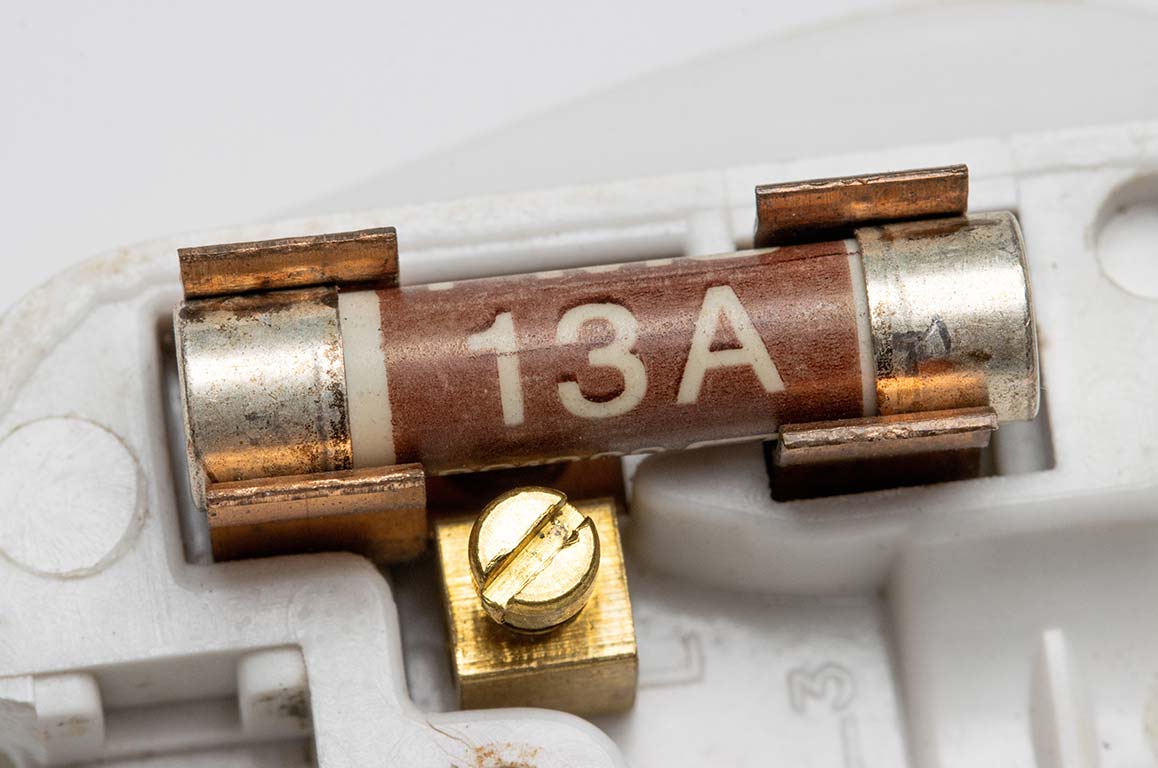
- Higher-powered appliances – often fitted with a 13A fuse
However, this is only a general guide and not a fixed rule. Some appliances with relatively low wattage may still require a higher-rated fuse due to design characteristics such as motor starting (inrush) current.
Motor-driven equipment in particular may require a higher fuse rating because the initial startup current can be significantly higher than the normal running current.
Working Out a Fuse Rating
If an appliance does not show a fuse rating and no fuse is present for reference, you can estimate the operating current using a simple calculation:
Power ÷ Voltage = Current
Divide the appliance power (in watts) by 230V (standard UK mains voltage) to estimate the current in amps.
For example, if an appliance is rated at 1900W:
1900W ÷ 230V = 8.3A
In this case, you would typically select the next highest standard fuse rating, which would be a 13A fuse.
However, this should always be checked against manufacturer instructions where available, as these take priority over calculated values.
IT Equipment and Lower Fuse Ratings
As a general guide, IT equipment such as desktop computers commonly uses 3A or 5A fuses depending on the power consumption and manufacturer specification.
Other devices such as monitors, printers, and external power supplies may vary, so fuse rating should always be confirmed where possible.
Conclusion
Correct fuse selection is an important part of electrical safety and PAT testing. Using the correct fuse ensures that equipment is properly protected against overload and reduces the risk of fire or damage in the event of a fault.